
Who sells it: the seller behind a CNshopper find, and what that seller usually allows
Four kinds of seller, how to spot each in CNshopper’s seller box, and the lines in the refund policy that apply to them.
The seller box on a CNshopper product page
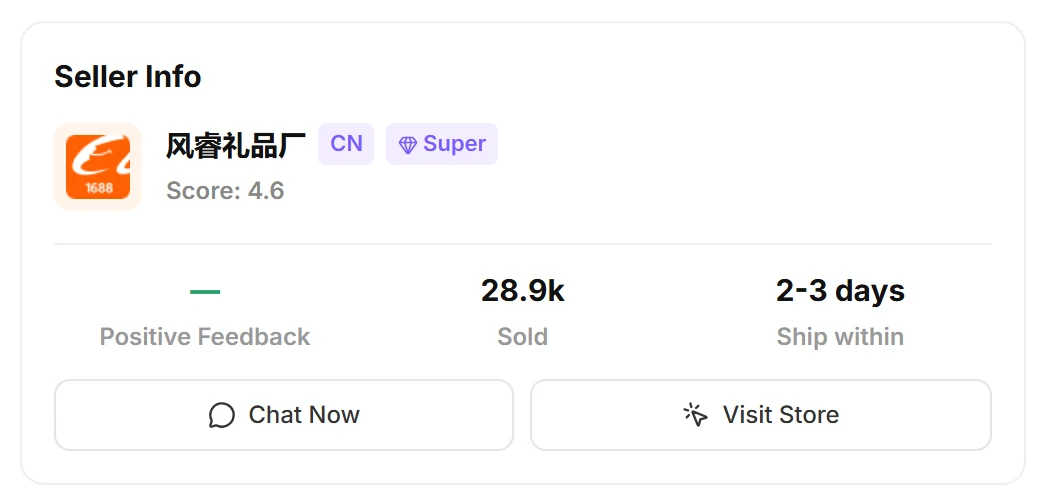
Every CNshopper product page has a box headed Seller Info, to the left of the title. It holds the shop name, a country code, two lines for positive feedback and items sold, the dispatch line, and two buttons, Chat Now and Visit Store. How much of it is filled in depends on the marketplace.
On the 1688 listing in the screenshot the box shows a badge, a seller score and a sold count. On the Taobao, Tmall and Weidian listings we opened on 17 October 2026 the feedback and sold lines were dashes. The dispatch line said “2-3 days” on all ten listings, which tells you it is not set by the seller. The shop name is the most useful line: words for factory, store, studio or flagship in it, or a person’s name, already sort the seller roughly into one of the groups below.
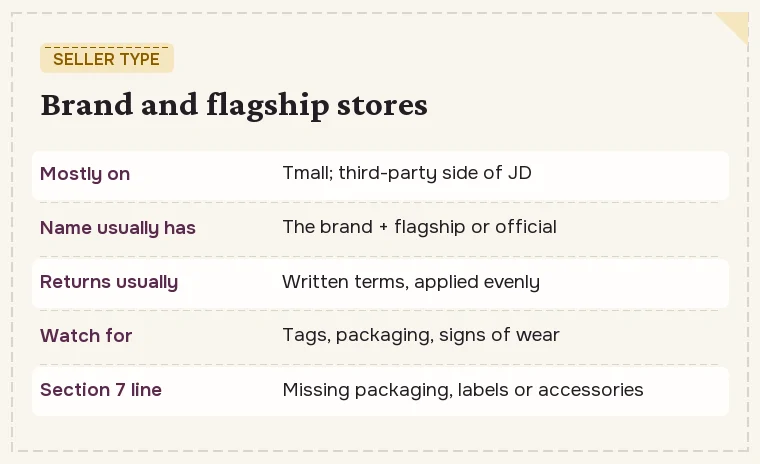
Brand and flagship stores
These are the official shops of a brand, or shops a brand has authorised, mostly on Tmall and on JD’s third-party side. Their names usually include the brand and a word for flagship or official store. They sell new stock, publish their return terms, and apply them the same way to everyone.
For a CNshopper order: stage two is the most predictable here, but the condition rules are strict. A return is usually refused if tags are cut, the packaging is missing or the item looks worn, and section 7 of CNshopper’s policy also lists goods missing original packaging, labels or accessories. Ask the warehouse to photograph, not open, anything sealed.
Registered shops of every size
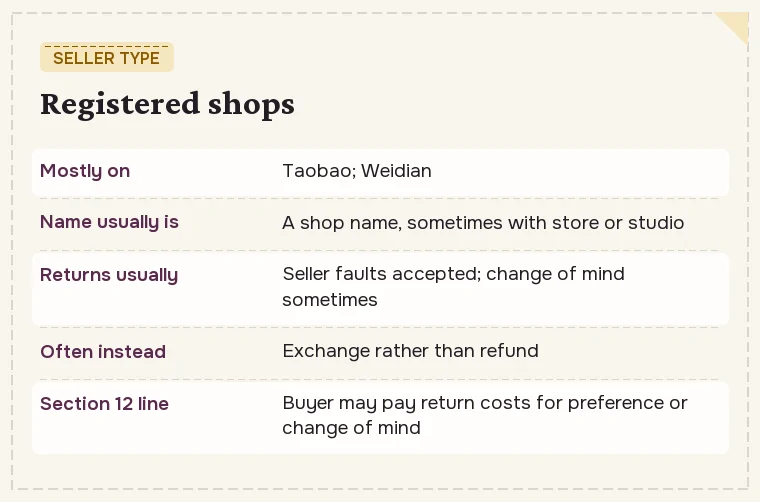
Most Taobao listings come from shops that are registered on the marketplace but are not brand stores: a two-person clothing shop, a family business selling kitchenware, a reseller with a warehouse. Weidian has many of the same kind. Their names are usually a made-up shop name, sometimes with a word for store or studio.
For a CNshopper order: stage two depends on the shop. Many will take back something they sent wrong and will sometimes take back a change of mind if you pay the domestic postage, which is what section 12 of CNshopper’s policy expects when the reason is the buyer’s preference. Smaller shops more often offer an exchange than a refund. Read the shop’s own return note in the listing; it is the closest thing to a rule you will get.
Factories and trading companies
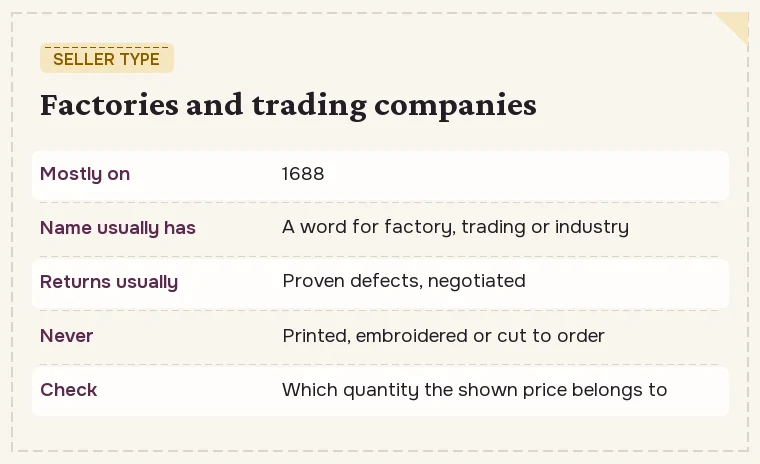
1688 is where these sellers are most visible, and a factory name often says so outright. Trading companies sell goods made elsewhere and often list the same item as several factories at slightly different prices. Both are set up for buyers ordering dozens or hundreds, and single-piece orders are a side line.
For a CNshopper order: expect returns only for a defect you can show, agreed one case at a time. Expect no return at all for anything customised, and section 2 of CNshopper’s policy warns that cancellation may not be possible once a made-to-order item is in production. Check the price tier: a price shown for a quantity of fifty is not the price of one.
Private sellers and the individual-seller line in section 7
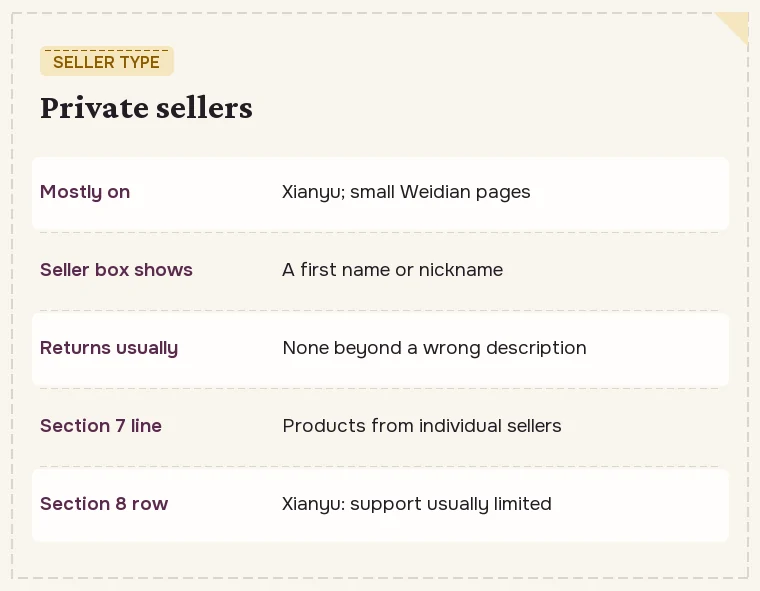
A private seller is a person, not a business: someone selling their own things on Xianyu, or running a small Weidian page for friends and followers. The seller box usually shows a first name or a nickname rather than a shop name. Section 7 of CNshopper’s policy names “Products from individual sellers” as something that may not meet the return conditions, and the section 8 row for Xianyu says support is usually limited because so many sellers there are individuals.
For a CNshopper order: plan on stage two being closed. A private seller may answer a polite question about a flaw, but there is usually no return process to fall back on. The value of buying from a person is often the item itself, something out of production or barely used; judge it on the seller’s photos and buy only what you would keep.
Second-hand, clearance and no-return listings
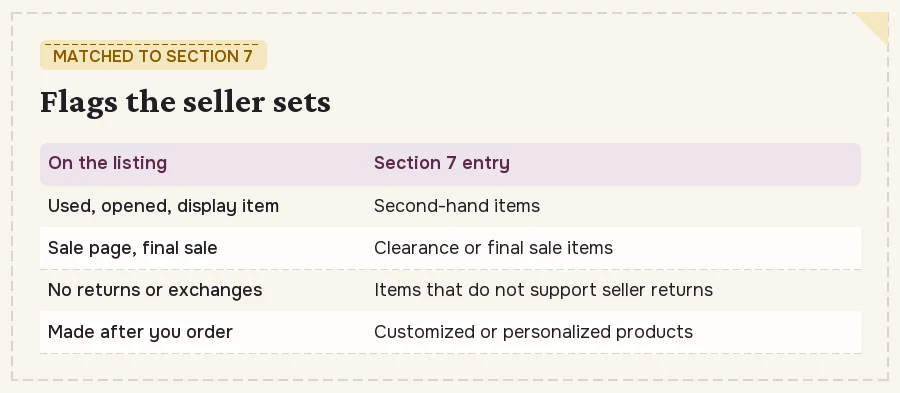
Some listings carry their own exclusion whoever the seller is. Section 7 names second-hand items, clearance or final-sale items, and items that do not support seller returns. On the marketplaces these show up as a condition note (used, opened, display item), a sale tag on a shop’s clearance page, or a line in the description saying no returns or exchanges.
For a CNshopper order: the seller has said it in advance, so CNshopper has nothing to argue with. If a size is uncertain, a final-sale listing is the wrong place to take the chance. In the Origin check, these are the flags that move stage two to “Unlikely”.
Choosing a seller before CNshopper places the order
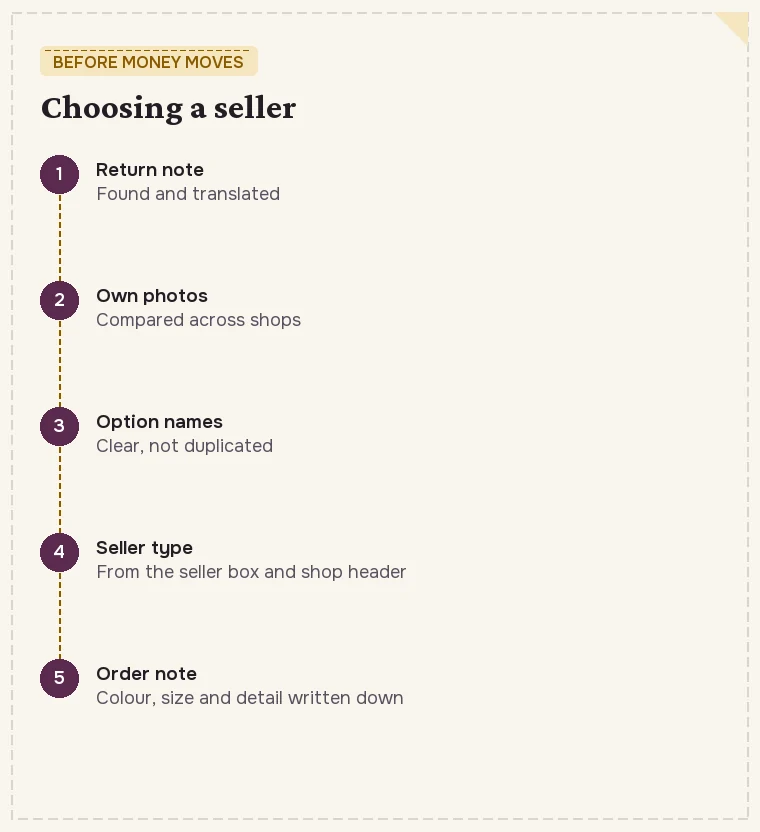
Choosing a seller well happens before any money moves. A short routine helps:
- Find the shop’s return note in the listing or the shop page, and translate it if it is in Chinese.
- Compare photos across a few shops selling the same item. A shop using its own photos, with the item on a table or a person, usually knows its stock.
- Read the option names. Vague or duplicated options are where wrong items come from.
- Look at the seller box on CNshopper’s page and the shop header on the marketplace for the seller type.
- Write what you expect (colour, size, any detail) in the order note, giving the warehouse photos a reference point.
Good sellers are not the ones with the lowest price; they are the ones whose listings answer your questions before you ask them. Bad signs are just as plain: one stock photo reused across many colours, a size chart copied from another shop, or a description that contradicts the options.