Seven listing sites and what each leaves CNshopper to work with
CNshopper’s market table, our link test of 17 October 2026, and the usual seller practice on each marketplace, one section per site.
Section 8 as CNshopper printed it
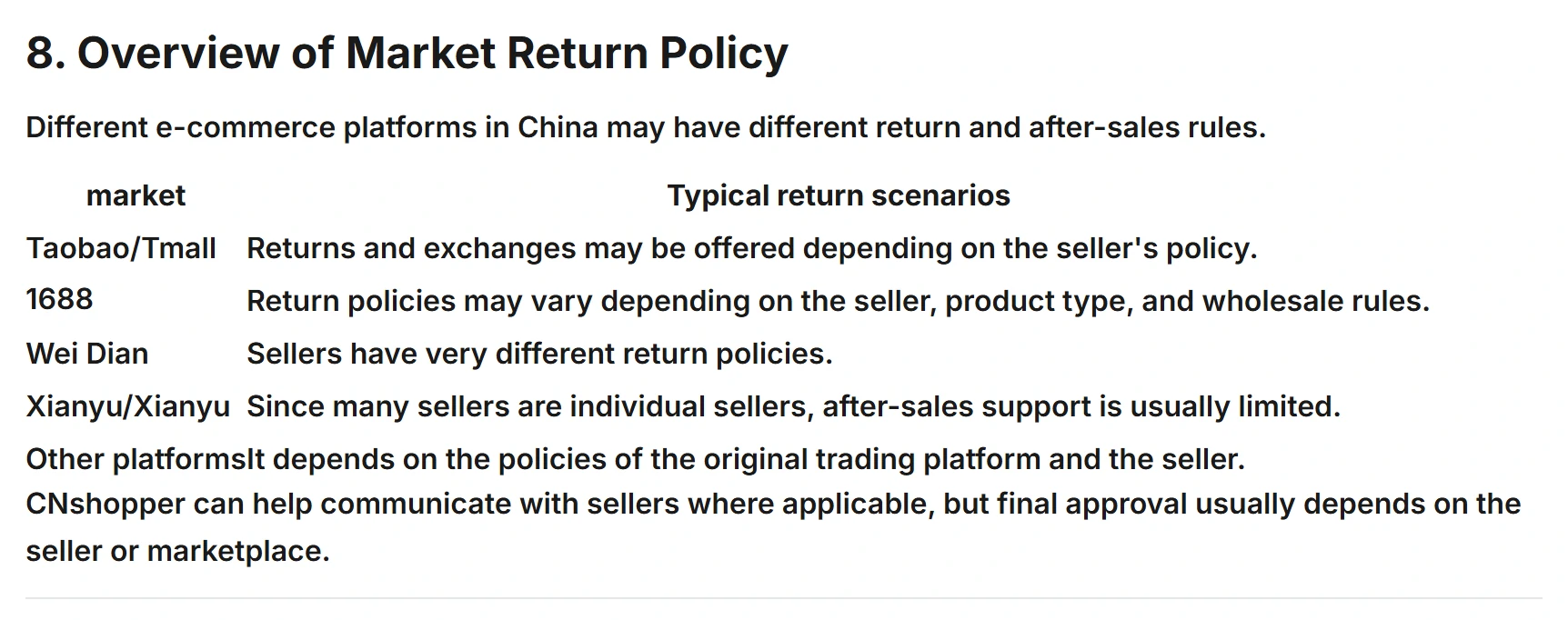
This is the table from CNshopper’s Return & Refund Policy, captured on 17 October 2026. It is the only part of CNshopper’s published terms that treats marketplaces differently, and it stops at five rows. Below it the policy adds that CNshopper “can help communicate with sellers where applicable, but final approval usually depends on the seller or marketplace.”
Each section that follows takes one line of the table, adds what happened when we pasted real links from that marketplace into CNshopper, and describes how sellers there usually handle a return requested by an agent. The usual-practice notes are our reading of how this trade works; CNshopper does not promise any of them.
Taobao: the shop writes the rules, and the link opens
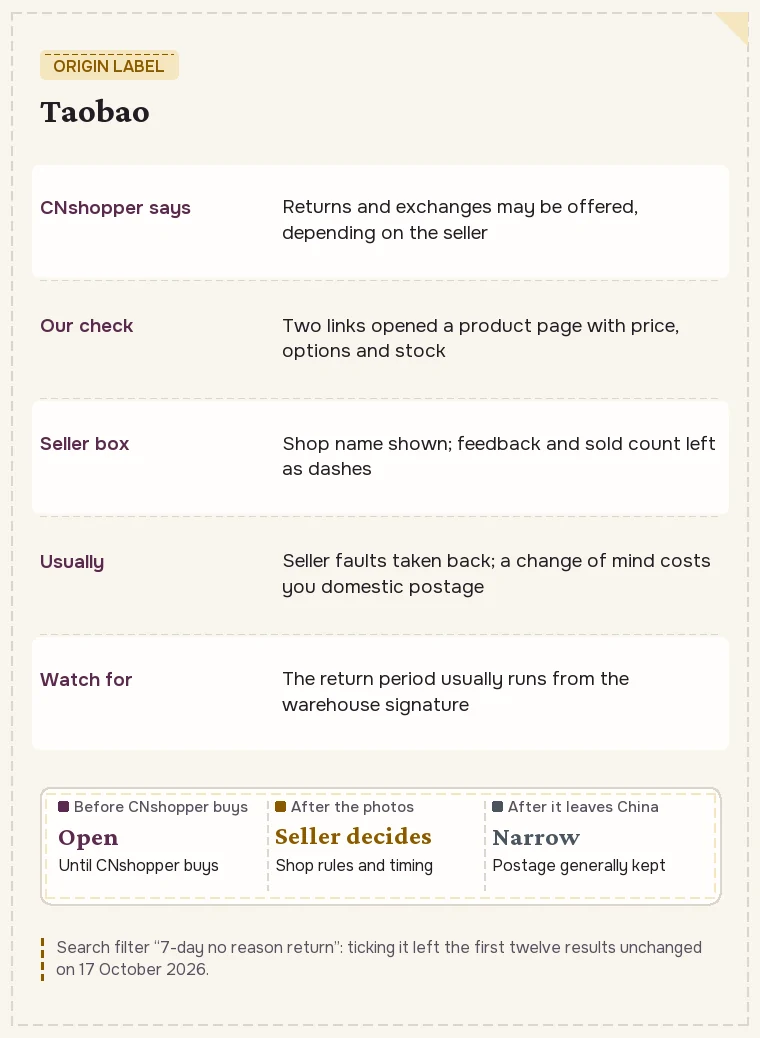
CNshopper says: returns and exchanges “may be offered depending on the seller’s policy”. Our check: both Taobao links we pasted opened a CNshopper product page with a price, translated options, stock per option and an Add To Cart button. The seller box showed the shop name, but the feedback and sold lines were dashes, and the dispatch line read “Ship within 2-3 days” exactly as it did on every other listing we opened, whatever the marketplace. Treat that line as a page default rather than a promise from the shop.
Usually: Taobao holds everything from one-person shops to companies with warehouses. Many listings carry a return promise for domestic buyers, and when an agent asks for a return because the seller sent the wrong size, the wrong colour or a damaged item, shops usually agree and pay the domestic return postage. A change of mind is different: the shop may accept it, but the return postage inside China is normally the buyer’s, and items such as underwear, cut fabric or anything opened from sealed packaging are often refused. The marketplace’s return period usually counts from the day the parcel is signed for, and for a CNshopper order the person signing is the warehouse, not you. Read the photos the day they arrive.
CNshopper’s search page shows a filter labelled “7-day no reason return”. On 17 October 2026 ticking it lit the filter up but left the first twelve results unchanged on every source tab, so we would not rely on it to sort listings for you yet.
Tmall: brand storefronts that CNshopper files under Taobao
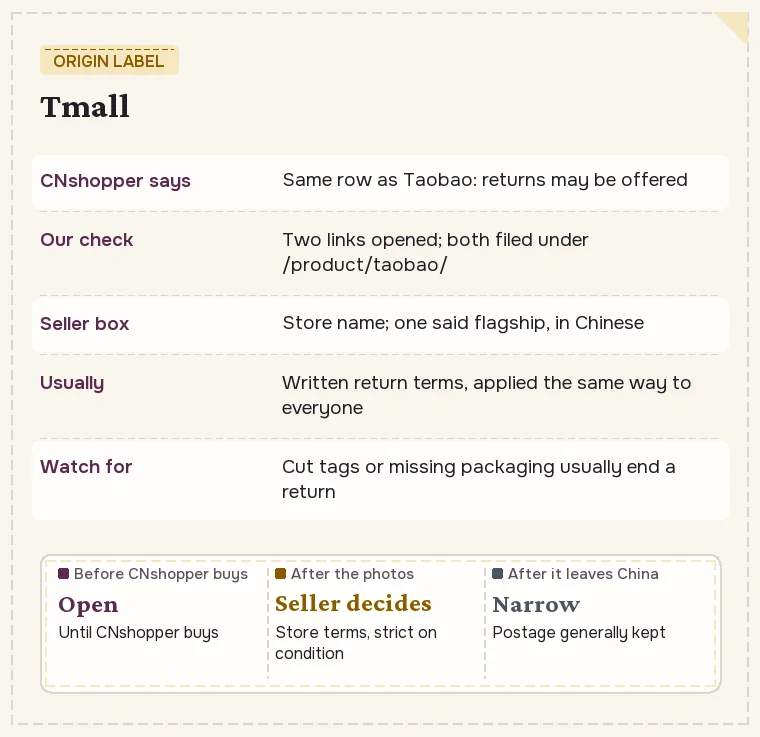
CNshopper says: the same row as Taobao. Our check: both Tmall links opened, and the address CNshopper gave each product page was /product/taobao/ followed by the item number. One of the two was a flagship store, and its shop name said so in Chinese in the seller box.
Usually: Tmall shops are registered businesses, many of them the official store of a brand or an authorised reseller. Their return terms tend to be written out on the listing and applied the same way to everyone, which makes them easier to predict. They also tend to be strict about condition: tags attached, packaging complete, no sign of wear. For an agent order that means the item should stay exactly as it arrived until you have looked at the photos and decided. If you ask CNshopper for extra photos of a detail, say that the tags must not be removed.
Because CNshopper treats Taobao and Tmall as one line, its section 8 tells you nothing extra about Tmall. The predictability comes from the store, not from CNshopper.
1688: wholesale sellers selling one piece at a time
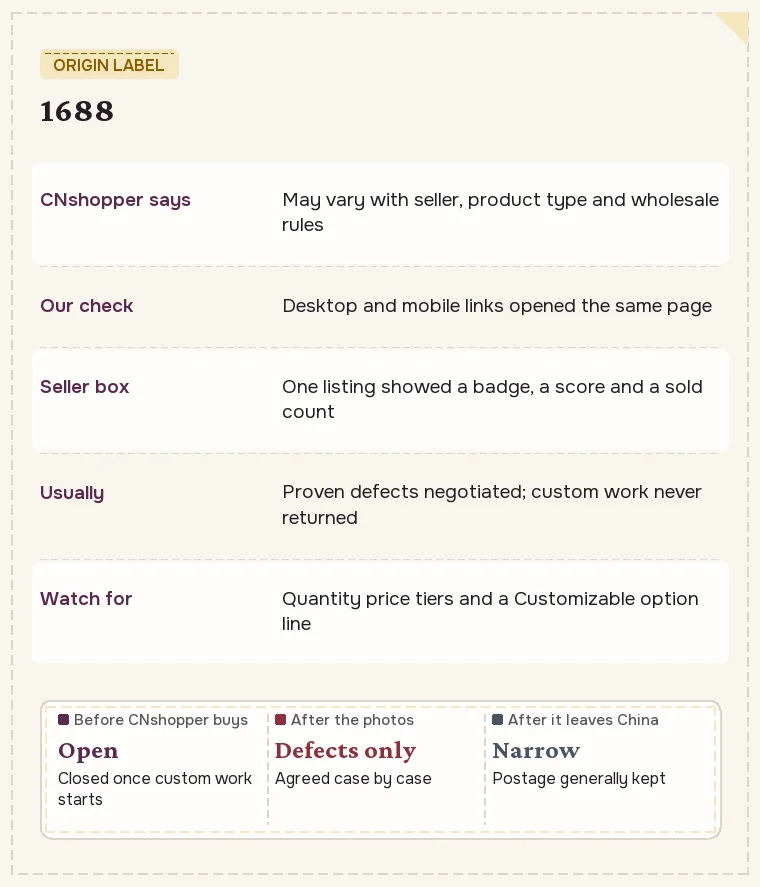
CNshopper says: return policies “may vary depending on the seller, product type, and wholesale rules.” Our check: desktop links (detail.1688.com/offer/) and a mobile link (m.1688.com/offer/) both opened the same product page. On one of the two listings the seller box carried a badge, a seller score and a sold count in the tens of thousands; the other showed a small sold count and no score. The first listing’s options ended with a line reading “Customizable”.
Usually: 1688 is a wholesale marketplace. The sellers are factories and trading companies, and many of them also send single pieces, which is how agent buyers end up there. Prices are often tiered by quantity, so check which tier the displayed price belongs to. Returns are usually accepted for a clear defect and negotiated case by case; a change of mind on a low-priced wholesale item is rarely accepted, and anything printed, embroidered or cut to your request is not returnable at all. When a 1688 listing offers customisation, ask for a proof photo through an order note before production starts.
CNshopper’s search also has a 1688 tab, alongside Taobao and Weidian. Filters on that page such as “Certified factory” and “Carefully selected” come from the marketplace’s own listing tags; they describe the seller’s status on 1688, not anything CNshopper has checked.
Weidian: one shop, one set of rules, often written in Chinese
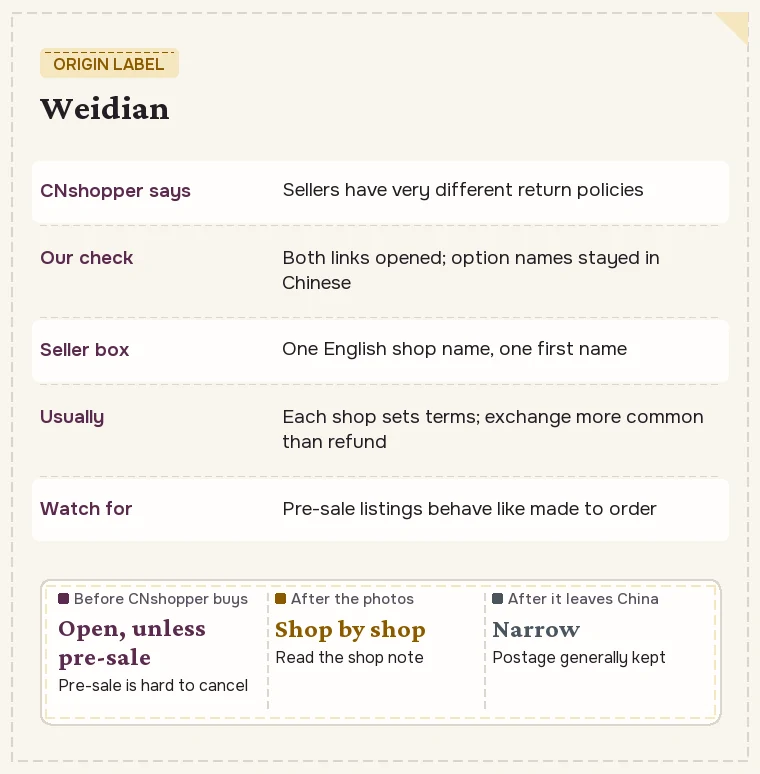
CNshopper says: “Sellers have very different return policies.” Our check: both Weidian links opened a CNshopper product page, but on both the option names stayed in Chinese while the titles were translated. One seller box gave a shop name in English, the other a person’s first name.
Usually: Weidian is a storefront app that small shops, studios and individuals use to sell to their own followers. There is no common return standard: each shop writes its own, usually in the listing description or in replies to messages, and plenty of shops offer an exchange for a wrong size but no refund. Weidian also has a lot of pre-sale listings, where the item is made or restocked after enough orders come in and dispatch takes weeks. Pre-sale and made-to-order are different conditions; check the listing’s dispatch and cancellation terms instead of treating them as interchangeable.
The untranslated options are the practical risk. If you cannot read the option names, copy them into a translator before you choose, and write the colour and size you expect in the order note, so there is something to compare the warehouse photos with.
Xianyu: private sellers and second-hand goods
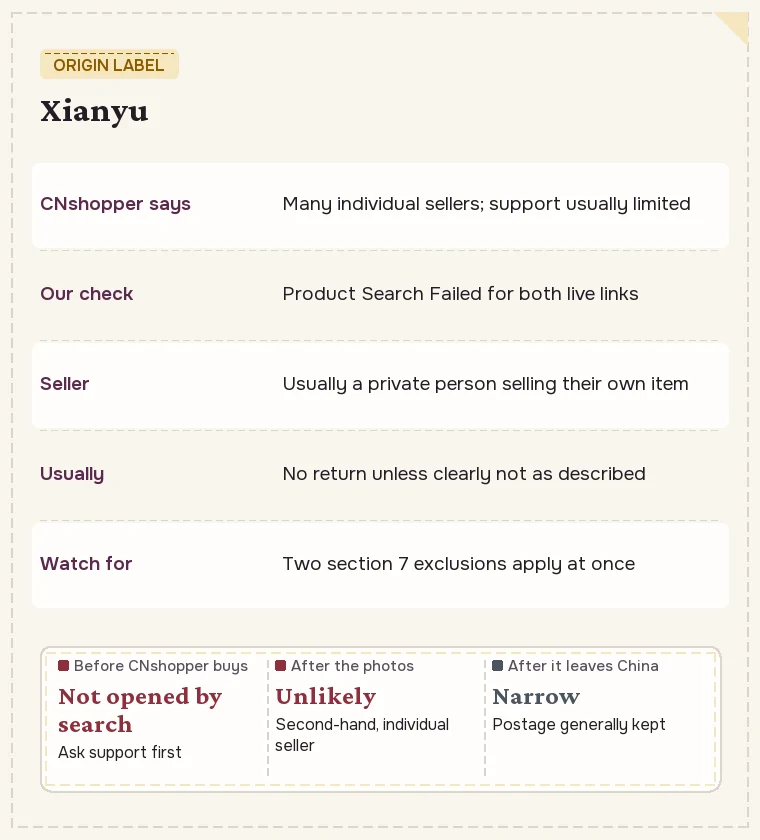
CNshopper says: “Since many sellers are individual sellers, after-sales support is usually limited.” The line is printed as “Xianyu/Xianyu”. Our check: two live Xianyu listings (links on goofish.com, taken from the marketplace’s home page that day) both produced “Product Search Failed” in CNshopper’s search box and nothing else. CNshopper’s own front-end code has no branch for that address.
Usually: Xianyu is a resale marketplace where most sellers are people selling things they own. The item is often one of a kind, the photos are the seller’s own, and the default is no return unless the item turns out clearly different from its description. Payment is normally held until the buyer confirms receipt, and when an agent buys for you it is the agent who confirms, usually once the item reaches its warehouse. After that the room to dispute shrinks.
Section 7 of CNshopper’s policy lists both second-hand items and products from individual sellers among things that may not be returnable, so a Xianyu find collects two exclusions at once. Buy it only if you would keep it with the flaws you can see in the seller’s photos.
JD and Xiaohongshu: named by CNshopper, not opened by its search
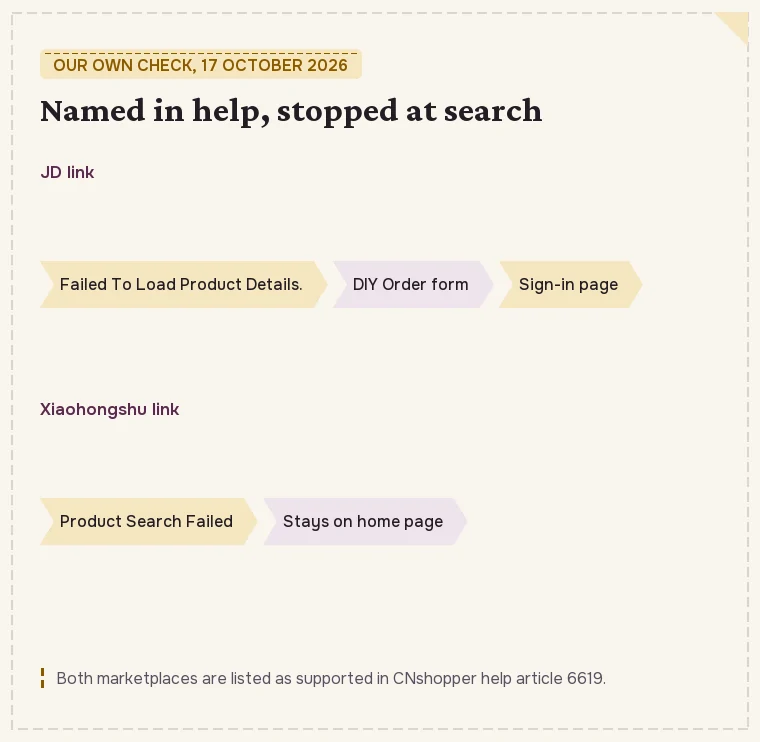
Neither marketplace has a line of its own in section 8, but CNshopper’s help article on warehousing and after-sales lists JD.com and Xiaohongshu among supported platforms. In our test, two JD item links (taken from JD’s home page that day) showed “Failed To Load Product Details.” and then moved to the DIY Order form, which asked us to sign in. Two Xiaohongshu links showed “Product Search Failed”. Xiaohongshu’s own website put up a security wall for our browser, so those two links were correctly formed addresses rather than listings we had opened ourselves; CNshopper’s code does not recognise the address either way.
Usually: JD sells two kinds of stock: goods JD holds and ships itself, which follow one standard set of return rules, and third-party shops with their own terms. Xiaohongshu shops live inside a content app, and their links usually travel as short share links. For both, the section 8 fallback applies: it depends on the platform and the seller. With no product page on CNshopper’s side, the order is typed in by hand, which is where options and notes go wrong.
Short share links and listings from anywhere else
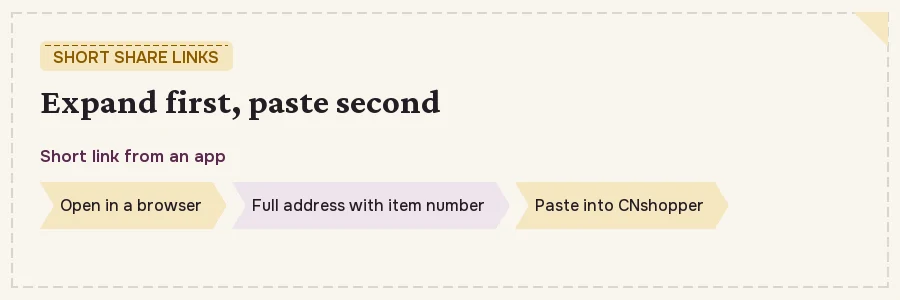
Apps share listings as short links. CNshopper’s front end treats addresses on tb.cn, qr.1688.com and youshop as a special case and hands them to its server to resolve. The one short Taobao link we tried ended on the DIY Order sign-in page. The reliable route is to open the short link in a browser, let it expand to the full listing address with the item number in it, and paste that.
For any marketplace not named above, section 8 has its catch-all row: “It depends on the policies of the original trading platform and the seller.” Read that as no guidance at all. Ask CNshopper’s support before ordering whether it can buy from the platform, and ask the seller, through an order note, what happens if the item arrives wrong.